After coming through her darkest hours, surprise French Open finalist Maja Chwalinska visited a tattoo parlour.
A tiny word - 'free' - was etched onto the 24-year-old qualifier's left hand.
Poland's Chwalinska, who is one win from joining Britain's Emma Raducanu as the only qualifier to lift a Grand Slam title, would not be drawn on why she chose it.
"I will keep it to myself. You can make your own stories," Chwalinska said.
After a Roland Garros run that was unthinkable a few weeks ago, it feels like there is big meaning in such a small word.
Five years ago, Chwalinska took an indefinite break from tennis after losing in the first round of qualifying at Wimbledon.
Chwalinska was suffering from a depression that left her feeling lifeless and unable to get out of bed. She had no idea when - or even if - she would return to the sport.
The Pole went back to her family home and sought help from mental health specialists.
When she was well enough, Chwalinska took up running and boxing as part of the recovery process and, after a four-month break, decided to go back to tennis.
Now, she stands one win away from one of the sport's biggest prizes after a stunning semi-final victory over Diana Shnaider in Paris on Thursday.
Qualifier Chwalinska sets up final against Andreeva
The past five years has seen Chwalinska work hard on the lower levels of the WTA Tour, diligently trying to improve her game.
Working on being able to mentally compartmentalise her career - which she associated with "pressure, stress and crying" - from the rest of her life has proved crucial.
A year ago, Chwalinska was playing tiny tournaments in Italian cities Brescia and Bari after going out of the French Open in the second round of qualifying.
Now she has won nine matches in a row at Roland Garros. One more will see her become the first qualifier in the Open era to lift the trophy here.
Maybe the tattoo represents how she has played over the past three weeks - with a freedom and joy that has captivated the Parisian crowds.
Chwalinska has earned notable wins over former French Open semi-finalist Maria Sakkari and Olympic champion Zheng Qinwen, as well as beating three seeded players in Shnaider, Anna Kalinskaya and Elise Mertens.
Playing with variety and spin, Chwalinska can lob, drop shot and moonball her opponents to distraction, but she can also hit with pace to finish off points quickly.
"I feel like I'm in the bubble. I don't know what's going on. I'm just very happy to be here," said Chwalinska, who has almost tripled her career prize money with the guarantee of winning at least £1.2m by reaching the final.
"After the tournament there will be time to process it and breathe in, breathe out."
Sometimes when tennis players fall to the court after a big moment it feels a little contrived.
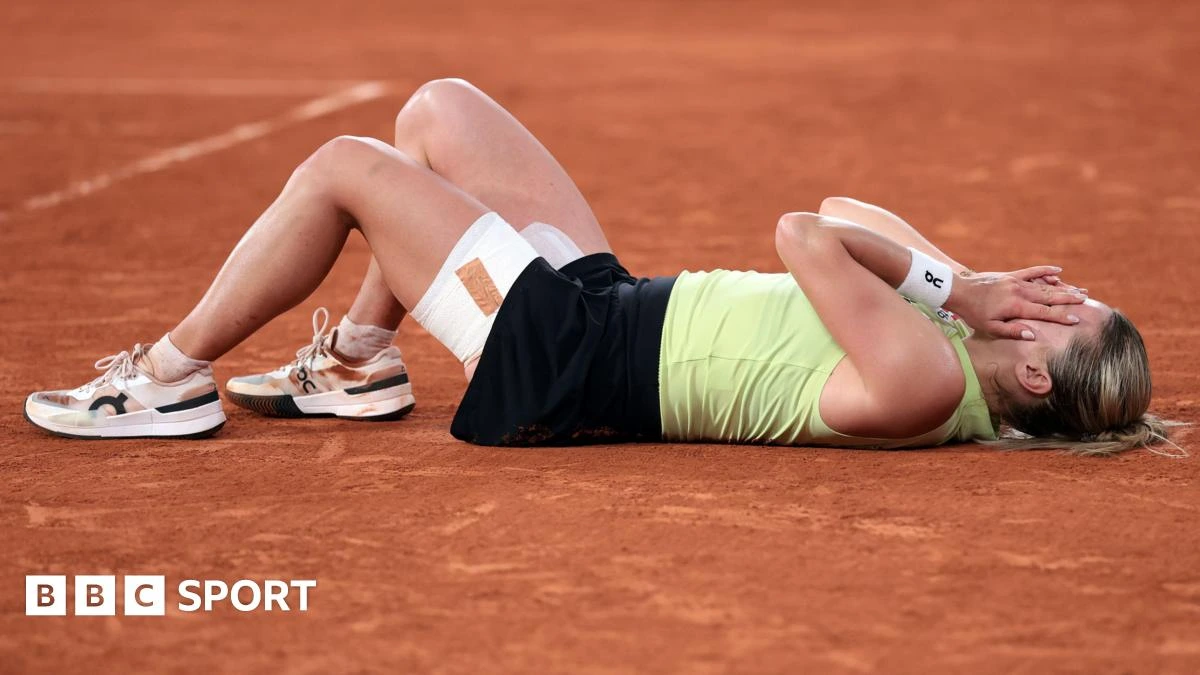
But the emotional toll of what Chwalinska had achieved was clear to see as she dropped to clay immediately after nailing a forehand winner down the line on her first match point.
"I don't know what was going on in my head. Joy, surprise - so many emotions. I felt so overwhelmed," Chwalinska said.
Chwalinska was helped over the line against Shnaider by thousands of Polish fans supporting her on Court Philippe Chatrier.
It is a fair assumption they had bought their tickets long in advance - largely because they assumed four-time champion Iga Swiatek, and not Chwalinska, would be competing.
Swiatek is absent from the semi-finals for the first time since 2019, but Chwalinska has managed to fill a void for her nation.
The pair are good friends, having reached the 2017 Australian Open girls' doubles final together, and were also Junior Billie Jean King Cup team-mates.
They even made their professional debuts at the same tournament - an ITF event in the small Polish town of Zawada in 2015.
If Chwalinska manages to beat Russian eighth seed Mirra Andreeva in Saturday's final, she will follow in Swiatek's footsteps.
And the French Open will be renamed, once again, to Poland Garros.
Related topics
Live scores, results and order of play
Get tennis news sent straight to your phone