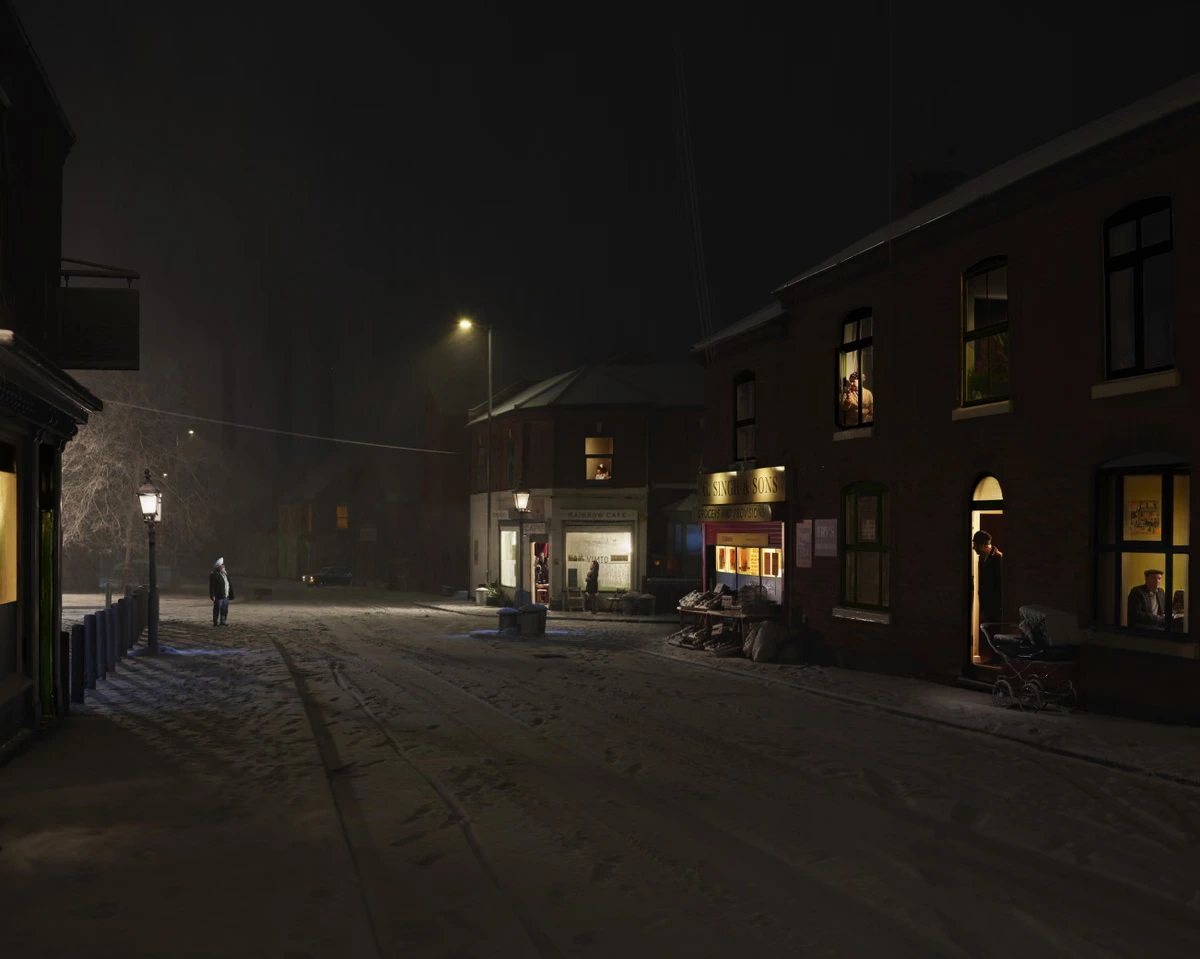
It was bitter in Walsall that winter of 1962-3 when snow turned the Black Country white. In After the Storm, Billy Dosanjh’s epic photographic reconstruction of one especially chilly night back then, an elderly Sikh man, recently arrived from the Punjab, stands under an old carriage lamp. He is, the shot suggests, seeing snow for the first time.
“I thought it was quite a fitting note to get him gazing at the snow, looking a little bewildered,” says Dosanjh as we stroll around Paths You Walk, his gripping exhibition of photographs, films and installations at the New Art Gallery Walsall. At the back of the image, three furnace smoke stacks rise up in ghostly fashion, almost like the three crosses on Calvary have been relocated to Mordor.
Like so much in the image, those chimneys disappeared as Britain deindustrialised and the Black Country became green country. In the 1960s, it was in those furnaces that Punjabi men came to do the work white British people did not seem to want.
Like the other people who populate this and other photographs in the show, the lonesome man caught in his reverie is portrayed by real-life locals who, nearly 70 years on, dwell in the redbrick back-to-back terrace houses of Caldmore, Palfrey, Pleck and The Butts – Walsall districts that saw a great deal of immigration from south Asia from the late 1950s onwards.
Backed by a National Heritage Lottery Fund grant, Dosanjh collected oral memories from first and second-generation migrants and transformed them into images that look as if they were made by a Black Country Edward Hopper, or a more politically overt Jeff Wall.
Signs from the times were painstakingly sought out for these images: Vimto ads, period cars, dodgy clobber. “There was actually a market here that sold monkeys, pythons and rat snakes.” The last of these would set you back £12, as a recreated – and hand-painted – sign for the show informs us.
“When I do my work,” says Dosanjh, “I want the people to enter the space of their ancestors psychologically.” Hence PayDay in which south Asian blokes feature in an authentic recreation of an early 1970s pub (one that clearly didn’t operate a colour bar to keep black and brown drinkers out). Then there’s the crouching Punjabi men being lectured by their white foreman in Furnacemen. Or the Sikh friends huddling around braziers in Walsall in Dayshift. Again and again, what’s striking is how Dosanjh finds beauty in images of alienation and abjection.
The Dosanjh family figures in these works. The Rainbow Cafe we see across the street from the Sikh man in After the Storm is a nod to his father’s enterprise of the same name. Dosanjh senior arrived from the Punjab in 1967 aged 14. He was typical of many south Asians who travelled 8,000 miles to work in the Black Country. These single men and boys, many with little English, lived in often overcrowded houses but, against the odds, made good lives for themselves. “By the time he was 17, Dad had bought a house and was working in foundries, then set up a cafe which used to have arcade games and a jukebox. Then I popped up.”
That was in 1981. Billy, now 45, was born in Smethwick which, after he left film school, became the locus of his work. His 2016 BBC film The Sikhs of Smethwick depicted how Ravi, a Christian of Punjabi ancestry, married Sonia, a Sikh born and raised in the Black Country – a match inconceivable a generation before. In such odd ways, Britain has been a land of opportunity, as well as one whose racism drove some immigrants to despair.
Dosanjh’s humane depictions of Sikh life feel suddenly topical as counters to the racist tropes now being deployed by far-right politicians in the wake of this week’s jailing of Vickrum Digwa for stabbing student Henry Nowak to death with a ceremonial Sikh knife.
Dosanjh is developing similar projects for Stoke and Nottingham. He’s also hoping to make a feature film from his own script about one of the most painful periods in recent West Midlands history: the 2005 race riots in the Birmingham districts of Lozells and Handsworth. “There was a Pakistani-owned beauty product shop and a conflict arose between the Caribbean community and young Muslim men who, after 7/7, felt quite confused.” By “7/7”, he means the suicide bombings in London by four British Islamist extremists that killed 52 people and injured over 770. “I thought I need to make my film here, about this place, because it’s all there – different communities living together, empire, young people, confused identities.”
I have one last question: what are you trying to do with this work? “I never feel more alive than when I’m in the middle of doing something like this,” he says as we leave the exhibition. “It brings a good feeling for everybody really. It’s a way of celebrating who you are.”